Are 3D Printed Fishing Lures Durable? An Honest Answer
Are 3D printed fishing lures durable? What actually breaks, why through-wire and epoxy sealing are non-negotiable, and where printed lures honestly trail store-bought ones.
Auf Deutsch: Angelköder selber machen — Material, Ballast, Versiegeln
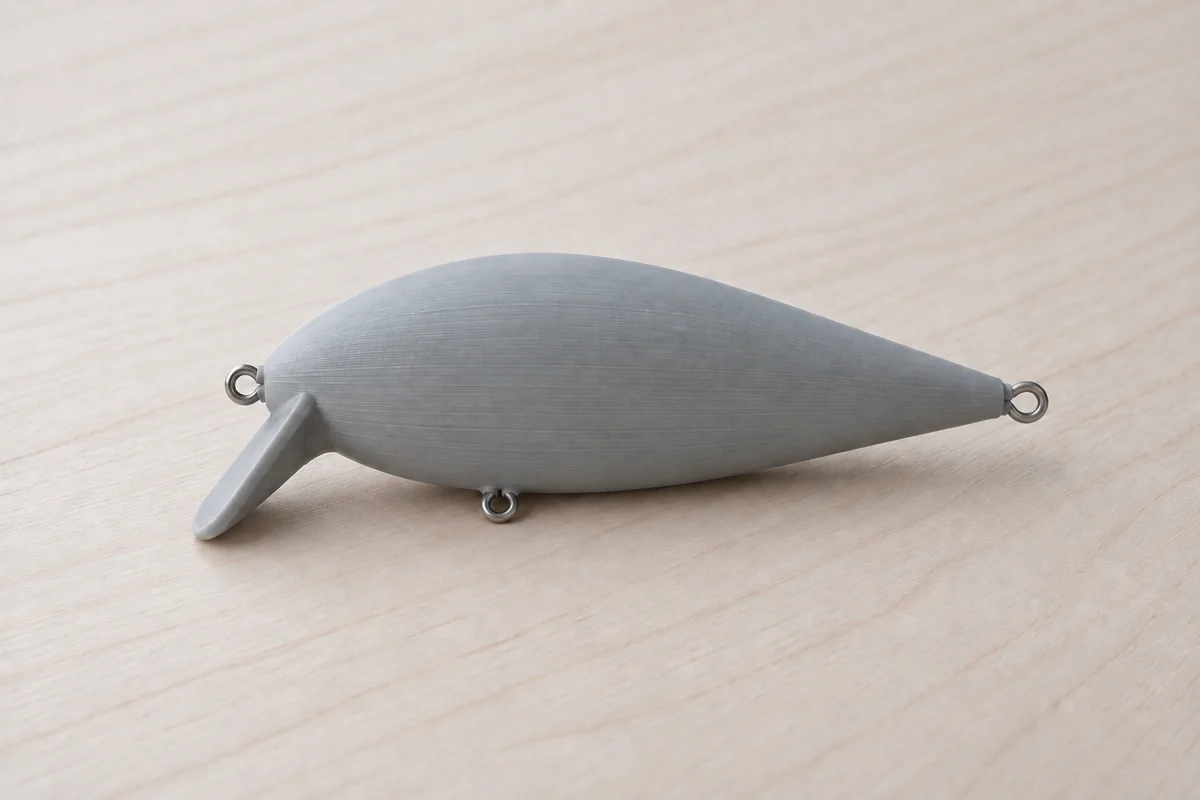
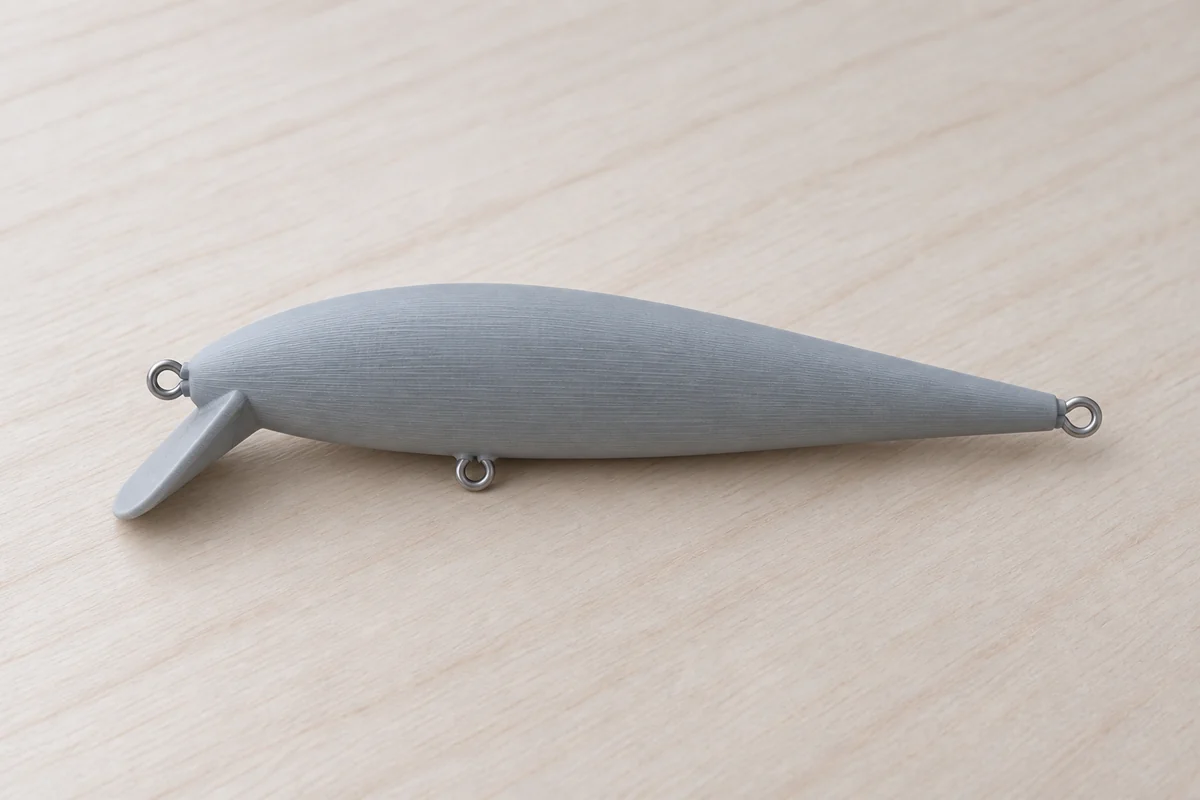
Short answer: yes — if three construction rules are followed. And honestly no, if they are skipped. The internet has both camps because both experiences are real: a lure printed as a hollow trinket and tossed in a lake fails fast, while a through-wired, sealed PETG body fishes for seasons. The difference is not luck. It is construction.
What actually breaks — and what doesn't
Three failure modes account for nearly every broken printed lure you'll read about:
- Hardware ripped out of the plastic. Screw eyes threaded directly into printed plastic hold against layer adhesion — the weakest direction of any FDM part. A decent fish, a snag, or a hard hookset pulls them straight out. This is the single most common failure, and it is fully avoidable: our bodies run a continuous stainless wire through the entire lure, nose to tail. The fish pulls steel against steel; the body just gives the lure its shape and action.
- Water in the body. An FDM print is not watertight. Microscopic gaps between layers wick water in, the lure gets heavier through the day, the action dies, and a floater turns into a slow sinker. Sealing the assembled body in epoxy closes the shell for good — which is why every one of our guides treats sealing as a required step.
- Brittle material. PLA cracks where PETG flexes. A lure bounced off a rock on a bad cast, dropped on concrete, or crushed in a tackle box survives in PETG far more often. That is why PETG is our recommended material for every lure body.
Why the wire changes the math
Through-wire construction is the same principle used in quality balsa lures: the line tie, the hook hangers, and the tail eye are all formed from one continuous stainless wire. Every force a fish can apply travels through that wire, not through the printed plastic. The printed body determines how the lure swims; the wire determines whether the fish stays on. Skip it and you are trusting a hookset to plastic layer adhesion — don't. Our through-wire guide shows the channel design and the bend sequence.
The coat is armor — and armor wears
A sealed lure's epoxy shell takes everything the water throws at it: teeth, gravel, hook rash from swinging trebles. It scratches. That is what it is for. The maintenance model is the same as for hand-made wooden lures: when the coat looks chewed up, scuff it with fine sandpaper and roll on a fresh thin coat of epoxy. Ten minutes of work returns the lure to service. A worn coat is not a broken lure.
Where printed lures honestly trail store-bought ones
Fairness matters, so here is the other side. Injection-molded ABS bodies from the big brands have a harder, more uniform surface than an FDM print with a hand-applied epoxy coat — factory lures shrug off gravel a bit better and never show layer lines. Printed lures also depend on the builder: a rushed seal job or a cold, under-extruded print will not match a factory part. What you get in exchange is a body shaped to your parameters, repairability, and the ability to reprint the exact same lure for cents when you finally donate one to a tree.
Hardware rules that keep it durable
- Stainless everything — wire, split rings, and hooks that match your water. Mild steel rusts from the inside of the epoxy shell outward.
- Ballast is tungsten, steel or brass — never lead. Denser tungsten sits smaller in the belly pocket, and we do not recommend lead in any build.
- Fresh, sharp trebles. The printed body will outlive cheap hooks; see the hardware guide for sizes.
The bottom line
Durability is not a property of "3D printed" as a category — it is a property of the build. Through-wire plus epoxy plus PETG produces a lure that fishes like handmade wooden baits have for decades: tough where it counts, honest about wear, and fixable on your bench.
 PETG filament 1.75 mmThe material we design for — tough, water-safe, easy to print.
 2K epoxy, crystal clear (500 ml)The required sealing step — one small kit covers many lures.
 Stainless wire 1.0 mm (304)For the required through-wire. Straight, formable, rustproof.
Frequently asked
Can a fish break a 3D printed lure?
A fish never pulls against the plastic on a properly built lure — it pulls against a continuous stainless wire that runs through the whole body. For the printed shell to fail, the fish would have to crush the body itself, which sits well outside what hook-sized fish do. Bite marks and scratched coating are normal; structural failure with through-wire construction is not.
What about pike and other toothy fish?
Teeth scratch the epoxy coat — the same thing they do to the paint of store-bought lures. The coat is sacrificial: when it looks chewed up, lightly sand and re-coat. Use a wire leader for toothy fish, exactly as you would with any lure you care about.
How many fish does one printed lure survive?
We don't publish a number, because it depends on your print quality, your sealing job, and what you fish for. The honest frame: the wire axle outlasts the coating, and the coating can be renewed. Treat the printed lure like a wooden handmade lure, not like a disposable soft bait.
Do 3D printed lures fall apart in water?
Unsealed, eventually yes — FDM prints have microscopic gaps between layers, and water finds them. That is why epoxy sealing is a required step, not a suggestion. A sealed body is watertight; the plastic itself does not dissolve or rot.
Is PLA durable enough for lures?
PLA works if it is sealed just as thoroughly, but it is more brittle on impact and softens at lower temperatures — a dashboard or a hot tackle box in summer can deform it. PETG is the more forgiving choice for anything that gets used hard.
Every Fishing3D file ships with the guides that match it — print profiles, assembly, sealing, tuning. Ordering opens soon — leave your email for a single heads-up.