Hooks, Split Rings and Wire for 3D Printed Lures — the Hardware Guide
Which treble hooks, split rings, wire and ballast a 3D printed lure needs: honest sizing rules of thumb, why everything is stainless, and why ballast is never lead.
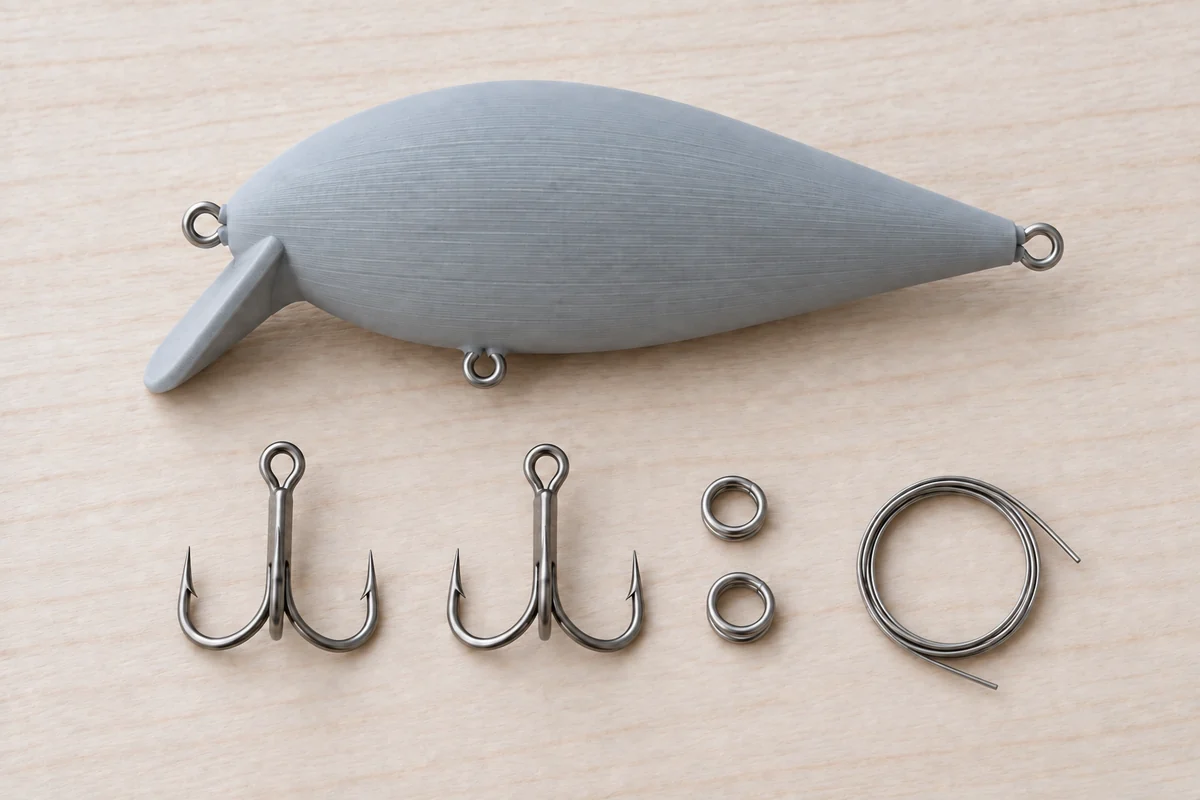
A printed body becomes a fishing lure through about two euros of hardware: one length of stainless wire, two or three split rings, one or two treble hooks, and a pinch of ballast. This guide covers what to buy, which sizes fit which builds, and the two rules we don't bend — stainless everywhere, and never lead.
The wire: 1.0 mm stainless, one continuous run
Every lure body in the catalog carries a printed channel for a single continuous wire from the line tie, along the belly, to the tail. Use 1.0 mm stainless steel wire (304 or 316) — stiff enough to hold its bends under load, soft enough to form with pliers. Hardware-store "craft wire" in mild steel rusts inside the sealed body; spring steel is too hard to bend cleanly at this diameter. One 10 m coil builds a season's worth of lures. The bend sequence — nose loop, belly hanger, tail loop — is in the through-wire guide.
Treble hooks: the size is on your parts list
Each purchased package names its treble size, because hook size follows body size and action — a heavy hook on a small floater kills the action, an undersized hook on a big crank costs hookups. The catalog rule of thumb:
- #6 — the small bodies, around 5 cm, and most 7 cm builds.
- #4 — the mid-size workhorses, most 9 cm builds.
- #2 — the big 11 cm bodies and the largest topwaters.
Quality matters more than brand: fresh, chemically sharpened trebles from VMC, Mustad, Gamakatsu or Owner all serve. Replace hooks when points dull or arms bend — the printed body will outlive many sets.
Split rings: 3–5 mm, stainless, nothing exotic
Rings connect the wire loops to the hooks and give the treble its free swing. 3–4 mm rings suit the small and mid bodies, 4–5 mm the large ones. Buy stainless; a 200-piece assortment costs less than one store-bought lure and covers every build in the catalog. Split ring pliers make the job pleasant but a fingernail and patience also work.
Ballast: tungsten, steel or brass — never lead
Floating builds carry one ballast pocket, sinking builds two. The pocket geometry assumes dense material: tungsten putty is the most convenient — it presses into the pocket, stays put, and lets you fine-tune buoyancy at the water. Steel or brass slugs work at slightly larger volume. We never recommend lead: it is toxic in the water column, increasingly banned, and simply unnecessary when tungsten exists. The lure guide covers how ballast placement shapes the action.
Salt water note
Everything above assumes fresh water. In salt, rinse lures after use and accept that even "stainless" grades eventually pit — 316-grade wire and saltwater-rated hooks buy you time. The sealed body itself does not care about salt.
The two-euro shopping list
Per lure: ~20 cm of 1.0 mm stainless wire, 2–3 stainless split rings, 1–2 trebles in your parts-list size, a gram or two of tungsten putty, plus a share of an epoxy kit for the required sealing step. The links below go to products we would buy ourselves — and the parts list in every package repeats the exact sizes for your build.
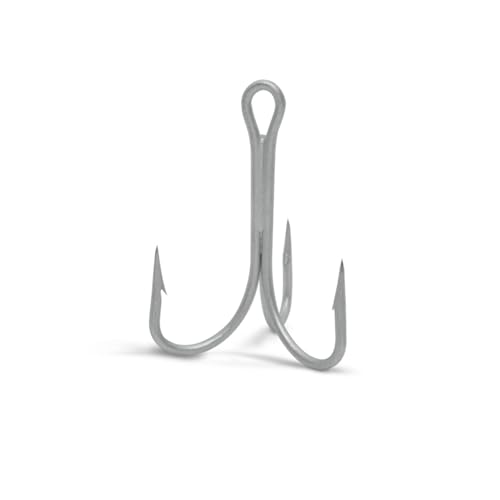 Treble hooks (VMC)Your parts list names the exact size — #6, #4 or #2.
 Stainless split rings 3–5 mmConnect hooks to the wire eyes — stainless only near water.
 Stainless wire 1.0 mm (304)For the required through-wire. Straight, formable, rustproof.
 Tungsten putty (lead-free ballast)Fine-tune buoyancy at the water. We never recommend lead.
Frequently asked
Why don't the files come with hooks?
Because hooks are consumables and preferences are personal. You buy the design once; hooks you will replace over the lure's life. Your parts list names the exact treble size for your build, so buying the right pack takes one click.
What size treble hooks do I need?
The parts list in your package names the size — #6, #4 or #2 depending on the body you configured. As a rule of thumb across the catalog: small bodies around 5 cm run #6, mid-size bodies run #6 or #4, and the biggest bodies run #2.
Can I use screw eyes instead of through-wire?
Not with our bodies, and we would advise against it in any FDM lure. Screw eyes hold in printed plastic only via layer adhesion — the weakest direction of the print. The through-wire channel is part of every body we sell, and the wire is the load path from line tie to tail.
Do I really need stainless split rings?
Yes. A rusty split ring is the cheapest part on the lure and the one that loses the fish. Stainless rings in the 3–5 mm range cost a few cents each and remove the problem.
Why never lead ballast?
Two reasons: lead is toxic to waterfowl and increasingly restricted in fisheries, and it isn't necessary — tungsten is denser and sits smaller in the ballast pocket, steel and brass are cheap and clean. Our ballast pockets and parts lists are designed around tungsten, steel or brass only.
Every Fishing3D file ships with the guides that match it — print profiles, assembly, sealing, tuning. Ordering opens soon — leave your email for a single heads-up.